Digital Product Strategy
What's happening with AI in retail, for real.
My reflections from hosting a tech leaders roundtable on the realities of AI adoption in large-scale retail.
Our conversations with executive leaders across all industries continue to find the same thing. Realising AI capability, at a strategic level, is about far more than the technology itself.
Over the last few months, Red Badger has done something of a roadshow, speaking with Technology, Business and Product leaders from across the sectors we typically serve - Retail, Financial Services and the Public Sector - to understand how they're realising AI within their organisations.
These are senior leaders, charged with running enterprise AI programmes across the people, technology, customer, platform and operating model levels.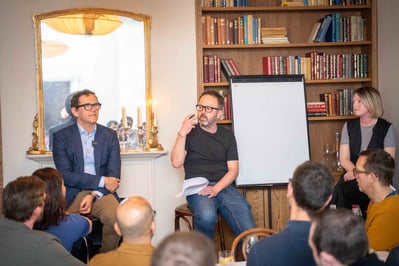
We've spoken to dozens now. Open questions - what's proving tricky, what's been a quick win, where are the unseen challenges, and what's the thing keeping you awake at night?
What we've found has made it clear that, already, we are a long way past the 'peak of inflated expectations' that Gartner describes in its Hype Cycle graph.
The common assumption is that companies are wrestling with the AI vendors they should be committing to, and how they can 'agent' their way to unimaginable efficiency (read cost savings).
The reality is much different, and altogether more human. The hard part isn't the new technology. The hard part is acting on what the new technology shows them. And often it’s also acting in a new way.
Every conversation has a version of this story.
A retail CTO, whose token spend would make Jensen Huang grin, has been finding that AI is helping him move faster, with more agility, and tackle arduous challenges humans would have hated.
He built an AI-enabled capability that gave him clarity over his national stock levels. It showed that some product lines had seventeen years of cover sitting in stores and warehouses. Add in all the other over-stocked lines, and there was £5 million of working capital tied up on shelves.
As anyone would, he emailed the planogram team - "I've noticed something, we've got a problem, take a look and let's fix this".
No answer.
It took several follow-ups, he told us, before he got a response - "These emails are overwhelming, we're doing what we normally do, please leave us to it".
He told me this with the smile an executive saves for the end of a long week. What more could he do? AI had unlocked the data visibility, it had suggested a next best action; it did its half of the bargain. The practical challenge, however, remained with the team working together to fix the problem.
This is the kind of thing we keep hearing.
Another example - an executive of a global bank told us he's deploying generative AI across most of his workforce while still closing out major regulator fines for data quality. Two different programmes, he said, that happen to share a budget line. Where the board sees the first, the regulator sees the second. This leaves everyone in the bank knowing that scale is dependent on real change.
A retail tech director told us that every quarter she sits in front of her CFO and CEO and explains why her cost line is higher than it used to be. Every other function in the business is asking her to do more with AI. No one seems to connect those two facts or link to a strategic AI approach that joins them.
A senior data and AI executive at a large multinational told us that the foundations under her business are, in her own words, "shoddy" and have been for twenty years. AI hasn't created that problem. It's just made the problem more visible and more expensive to ignore.
It's tempting to read these as failures. They're not, really. They're what it looks like when the speed of technology capability moves faster than the speed of organisational capability. AI isn't the first technology to do this. Email did it. The web did it. Cloud did it. Each time, the firms that came out ahead weren't the ones that bought the most of the new thing. They were the ones who focused on fixing the coordination problem, the new thing exposed.
What's different about AI is the pace. The £5 million is visible in a daily email. The fines arrive within twelve months. The board, the CFO, the regulator and the team on the floor are all reading the same announcements at the same time, and forming different views about what should happen next. The gap between those views is widening, not closing.
What is being described, in different language, is the same underlying problem.
 The board has approved a strategy that the floor can't execute. The CEO has committed to a roadmap, but the rest of the organisation isn't yet built to run it.
New technology has arrived faster than the people and platforms underneath it can reshape themselves to use it. This is the enterprise AI capability gap, and it's the biggest thing standing between strategy and outcome at almost every firm we've spent time with.
This is what our upcoming event is built to explore, and why we’ve pulled together the strategy leaders with the broadest view. Imperial College London, on how senior leaders ought to be educated for a phase change the existing executive programmes weren't designed for. Zebrafish, the education company backed by Imperial, on the workforce reskilling problem at the heart of the gap. And our own work, on the products and engineering capability required to operate at the pace now demanded.
If any of this feels familiar - or if you're grappling with your own version of any of it - this is a room not to miss.

Add a Comment: