Customer Success
Red Badger launches CRUX - Headless app development in Rust
Announcing Red Badger’s experimental open-source framework for writing native User Interface (UI) applications for Mobile, Web, and Desktop.
What Rust Nation reminded me about enterprise software - and why the AI conversation was the one I didn’t expect.
Last week I had the privilege of spending two days deep in the world of Rust - first on stage at Rust Nation UK alongside Ludovico Rossi, a senior software engineer at Proton, then co-hosting a Rust & AI evening with our friends at Fractile.
I’m genuinely pleased we got to share that stage together: the work Ludo and the Proton team have been doing with Crux represents exactly the kind of enterprise Rust adoption that Red Badger set out to enable.
Day One: Crux in the Wild
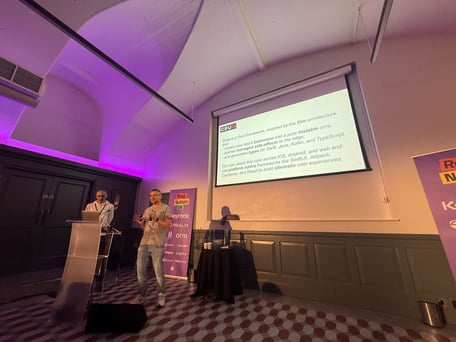 We first introduced Crux at Rust Nation in 2023. At the time it was a framework we’d built to solve a problem we kept encountering with enterprise clients: how do you share complex, correctness-critical business logic across iOS, Android, web, and desktop, without duplicating it or compromising on the native experience of each platform? Crux - a Rust framework embodying the Ports and Adaptors pattern, similar in spirit to Elm - was our answer. This year, we were back at Rust Nation to show what it looks like in production at scale.
Proton’s products - Mail, Calendar, Drive, VPN, PaaS, and the AI assistant Lumo - reach millions of users across iOS, Android, web, desktop, macOS, Windows, Linux, and TV. Every product is built on a single founding constraint: end-to-end encryption, everywhere. That’s a hard engineering problem at any scale. At Proton’s scale - 600 employees, teams structured independently around each product, offices across Europe - it becomes a genuinely significant architectural challenge.
What Ludo laid out for the audience was a pattern many engineering leaders will recognise: Conway’s Law in action. Proton’s autonomous, product-focused teams are excellent at moving fast. But that same autonomy had historically led to duplicated implementations of the same business logic across platforms - increasing inconsistency, multiplying bugs, and making cross-product integration harder than it needed to be. The question Proton needed to answer was: how do you empower teams to work independently on shared functionality?
The answer they arrived at - and that Red Badger has been helping them build out - is a modular Crux architecture where individual teams own their own Crux “cores”, which can then be shared across many platform “shells”. The centrepiece of the talk was a live demo using two standalone example apps - Ask Lumo, an AI assistant, and Proton News. Ludo showed how the Ask Lumo Crux core could be embedded directly inside the Proton News app, reusing both its behaviour and its UI. No duplication, no renegotiation between teams. One team owns Ask Lumo; another team's app simply picks it up as a module. That composability - the ability to combine independently-owned Crux cores into new product experiences - is what makes the architecture compelling at Proton's scale, where the number of products and cross-product integrations keeps growing.
The questions afterwards were sharp and specific - from engineers who recognised the problem we were describing. Rust in the enterprise is no longer a theoretical proposition.
Day Two: Rust Meets the AI Era
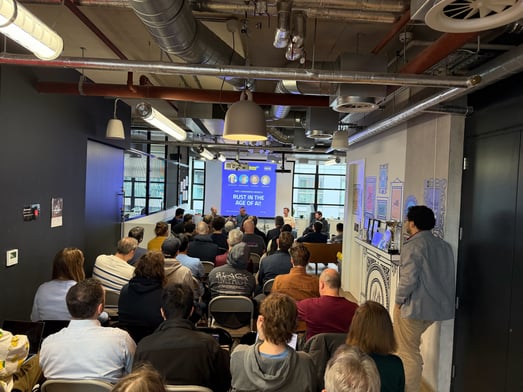 The next evening, we co-hosted a Rust & AI event with Fractile at our HQ in Old Street. The format was deliberately open: a panel followed by a wider discussion, with a room full of engineers and engineering leaders who had plenty to say.
What struck me most wasn’t the enthusiasm for AI coding tools - that was a given. It was the honesty. Engineers shared real experiences: AI-generated code that had quietly rewritten large portions of a codebase and still failed to fix the original bug. The “vibe coding” energy that is genuinely exhilarating when it works, and quietly corrosive when it doesn’t. The question is what do software engineering practices actually mean when a model is doing an increasing share of the writing.
This is where I think Rust has a role that hasn’t been fully articulated yet. Not because Rust magically prevents bad AI output - it doesn’t - but because Rust’s type system and ownership model create friction that forces even AI-generated code to be thought through. The compiler is not optional and cannot be charmed. In an era where “but does it work?” is increasingly being answered by a model rather than a human, having a language that makes that question hard to answer carelessly feels genuinely important.
While we likely brought about more questions than we answered, as is often the case with panels, the conversation surfaced something worth sitting with: the properties that make Rust demanding for human engineers may be exactly what make it valuable in an AI-assisted world.
What it all points to
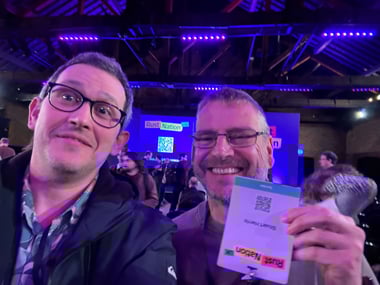 Two days. Two very different conversations. But the same underlying truth: Rust is growing up, and enterprises are paying attention. The organisations getting real value from it are the ones who have committed to the approach - not as a performance, but as an architecture. A modular Crux core isn’t an experiment. It’s a way of building software that compounds in value as it grows.
At Red Badger, we’ve spent years working through what that looks like in practice - the hard conversations about team capability, adoption paths, and how to structure a migration. Standing on that stage with Ludo last week, I felt the work paying off.
If you’re thinking about what Rust could do for your organisation, I’d genuinely love to talk.

Add a Comment: