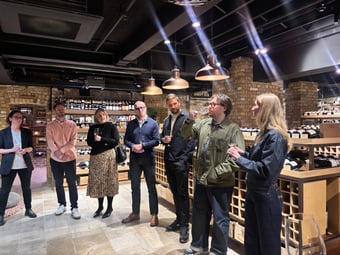
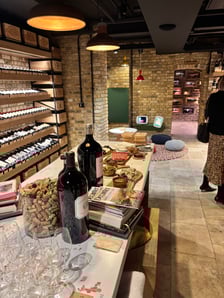
 Last week, I had the privilege of hosting some great minds in retail at Hedonism Wines in Mayfair, discussing what truly unified commerce looks like in practice. And the setting made its own argument for why physical retail still matters.
You don't visit a place like that for convenience. You visit because no algorithm has yet worked out how to replicate the feeling of being handed something extraordinary by someone who genuinely knows why it's extraordinary. That tension, between the irreplaceable and the scalable, ran through almost every discussion point of the evening.
We had leaders from Nudie Jeans, Burberry, and Dr Martens in the room, and one question kept surfacing: what should your channel actively not do?
Some of the most honest moments:
- Omnichannel doesn't mean identical. It means orchestrated. A ship-from-store order can introduce a customer to a shop they didn't know existed. That's not cannibalisation; that's the system working.
- A store that wasn't performing commercially became a fulfilment hub and everyone won.
- One hundred top local customers who'd never been reached digitally were found through a simple in-store email list. Loyalty doesn't always start in an app.
- Burberry shifted its delivery KPI from 'delivered on time' to 'whether the customer thought it was delivered on time'. Small change. Big difference. Fractured experience kills loyalty before it starts.
- Real loyalty isn't about points. It's about repeated behaviour becoming brand advocacy. Programmes built on solid data infrastructure are the connective tissue between store and screen, but only if the data is actually used.
- The most interesting AI deployments right now aren't customer-facing, they're empowering store colleagues, not replacing the human moment.
- Omnichannel without measurement is where ambitions go to die. If you can't explain the halo effect of a channel to your CFO, the budget for the interesting work won't come.
 The brands getting this right in 2026 aren't the ones with the most technology. They're the ones who've had the discipline to decide what each channel is genuinely best at, and the courage to let the others stop trying to do the same thing.
The store earns trust. The digital channel scales it. Loyalty programmes, when they're built on real infrastructure, are what connect the two. But the vision of unified retail keeps colliding with the reality: fragmented data, disconnected teams, and incentives that still reward channels for competing rather than complementing. Solving that isn't a technology problem first. It's an organisational one.
 Consistency of brand is non-negotiable. Consistency of experience was always a lazy shorthand. It's time we stopped treating them as the same thing.
Thank you to everyone who joined us, and to our partners at Sitoo and Talon.One for making the evening possible.
Rachael Rea-Palmer is Director of Retail and Hospitality at Red Badger, and previously a senior Product leader at brands including John Lewis and Net-a-Porter.
Red Badger is a digital product consultancy that works with enterprise organisations to build software that matters. We regularly host closed-door conversations for senior technology leaders. If you’d like to join a future session, get in touch.

Add a Comment: